Brand Identity Basics for Artists and Small Businesses
A logo may be the most visible part of a brand, but it cannot carry the whole identity alone. The brand starts feeling consistent when the logo, colors, typography, imagery, and voice support the same direction.
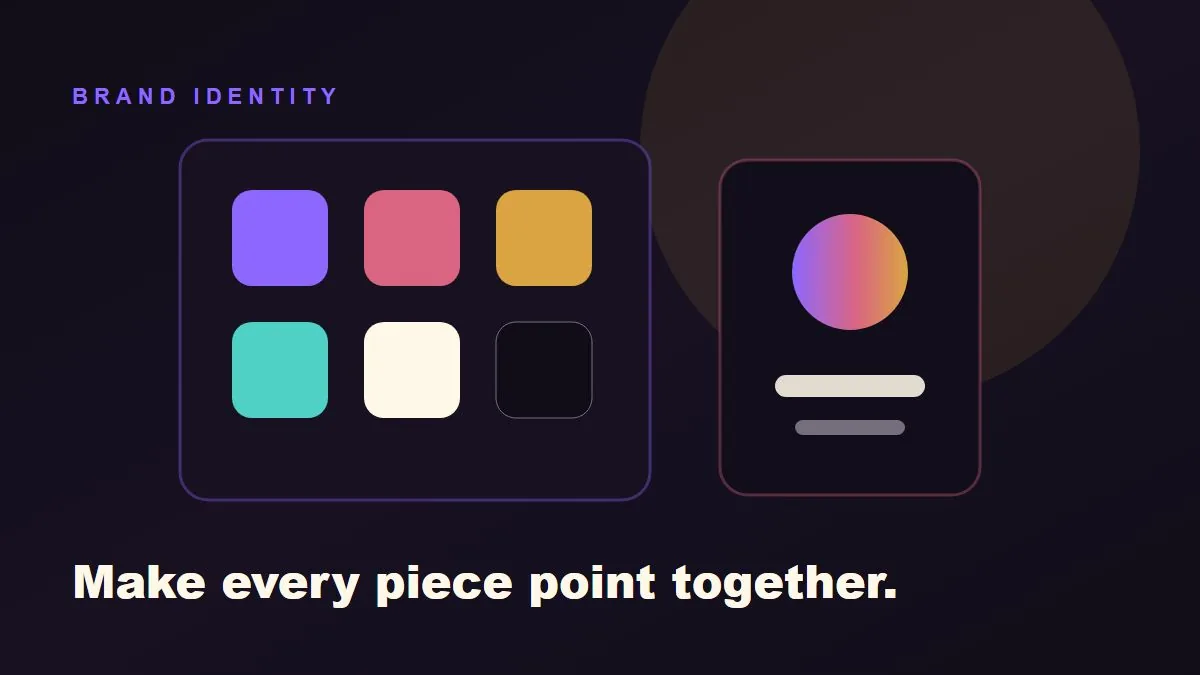
Brand consistency is a decision system, not a matching exercise
A consistent brand is not one that stamps the same logo on every surface. It is one that makes related decisions for the same reason. The Instagram post, invoice, website, release cover, and event flyer may need different layouts, but they should answer the same questions: What matters first? How should this feel? What should a person do next?
Build the identity as a small operating system. Define the inputs, assign roles, and create defaults. Then a new piece of work is not a blank canvas; it is a situation with known choices.
Write a one-line brief that can reject good-looking ideas
Start with: “We help [audience] do [useful thing], and we should feel [three compatible qualities].” An independent artist might choose “intimate, restless, handmade.” A cleaning and rental business might choose “clear, dependable, welcoming.” Avoid collections such as “luxury, playful, underground, corporate, soft, disruptive.” If every mood is allowed, the brief cannot make a decision.
Give each quality observable evidence. “Direct” might mean short headlines, active verbs, obvious buttons, and little decorative copy. “Handmade” might allow texture and imperfect marks but reject glossy stock imagery. “Calm” might mean generous spacing and restrained accents, not simply the color blue. The brief works when it can say no to an attractive option that sends the wrong signal.
Assign every identity element a job
Flexibility belongs inside the system too. Write down what can change by campaign, season, or format and which recognition cues should stay steady. A flexible identity can shift emphasis without asking every new piece to invent the brand again.
Use a role card instead of a mood board full of unexplained favorites. Give the logo, color, typography, image style, and brand voice separate jobs:
- Primary logo: full-name mark for headers, proposals, and spacious placements.
- Compact mark: readable option for avatars, favicons, and small labels.
- Lead color: the dominant field or strongest recognition cue.
- Accent color: reserved for actions, highlights, or moments of emphasis.
- Display type: personality in short headlines.
- Body type: clarity in paragraphs, details, and forms.
- Image rule: a repeatable choice about subjects, crops, light, texture, or illustration.
- Voice rule: the sentence pattern and vocabulary the brand uses in public.
Roles prevent silent drift. If every color is an accent, nothing is emphasized. If four fonts all carry “personality,” the reader must decode the hierarchy on every page. Defaults are not restrictions; they are the fastest safe choice.
Use a three-question decision gate
When a new design or message is proposed, ask these questions in order:
- Recognition: would this still belong to us if the logo were removed?
- Meaning: does the first visual and verbal signal match the one-line brief?
- Use: can the audience quickly find the title, essential information, and next action?
If recognition fails, check the color roles, type roles, image treatment, and voice. If meaning fails, the piece may be stylish but pointed at the wrong emotion. If use fails, do not solve it by adding more branding; repair hierarchy and contrast.
Three verified examples show how the system changes by context
The MstykArtz case study is artist-facing. The visible site structure brings artwork, collections, shop paths, artist information, contact, and custom-work inquiries into one focused presentation. The identity’s job is not to compete with the art. It needs to frame different collections while keeping the artist and the paths to browse or inquire legible.
The Wanderlust Rentals case study carries a different information load. Cleaning, commercial, residential, short-term rental, location, Blog, and quote paths all need to feel related while remaining easy to distinguish. Here, consistency supports orientation: recurring hierarchy and action patterns can connect several services without pretending they are the same service.
Quiet Moth Artz provides a third, visible example on this site. The dark plum fields, cream text, purple, rose, and gold accents, rounded panels, compact uppercase labels, and direct action language recur across service pages, articles, work, and the Request Form. The pages are not identical. The system decides what stays familiar while each page gives its own subject the lead.
These examples are useful because they do not suggest one universal aesthetic. An artist portfolio, a multi-service business, and a creative studio require different priorities. Consistency lives in the logic connecting choices, not in copying another brand’s palette.
Define voice with before-and-after choices
“Friendly and professional” is too vague to guide a caption. Write a small voice matrix. For example:
- Use: “Tell us what you need.” Avoid: “Kindly submit your valued inquiry.”
- Use: “Browse the collection.” Avoid: “Embark on a visual journey.”
- Use: specific service names. Avoid: broad claims such as “we do everything.”
Include button language, one short caption, one longer paragraph, and a customer-facing error or instruction. Voice becomes real at the edges: form labels, empty states, confirmations, and practical details—not only the homepage headline.
Run a five-surface brand audit
Before calling the identity usable, apply it to an avatar, a mobile website header, a square social post, a text-heavy flyer, and a plain document or invoice. These surfaces expose different weaknesses. A detailed mark may disappear in an avatar. Pale text may fail on a flyer. A dramatic display face may become exhausting in a paragraph.
When a test fails, adjust the system rather than inventing a one-off fix. Add a compact logo version. Define a darker neutral. Set a minimum heading size. Create a text-only template. One exception may be necessary; repeated exceptions are evidence that the rules are incomplete.
Make a one-page brand control sheet
A useful starter guide can fit on one page. Include approved logo versions and minimum-use notes; color values with assigned roles; headline and body fonts; two spacing or layout tendencies; image examples with “use” and “avoid” captions; three voice qualities; a headline, button, and caption sample; and the three-question decision gate.
Name files clearly and keep approved exports together. “logo-final-final2.png” is not a system. A folder with primary, compact, light, dark, and source versions gives future collaborators fewer chances to guess.
When the pieces need one direction
You can build the control sheet yourself when the core idea is already clear and the main problem is day-to-day drift. If the audience, message, logo direction, palette, type, imagery, and voice are pulling against one another, step back before producing more materials. The Brand Identity service is designed to organize those parts into one practical direction; Graphic Design can then apply that direction to specific materials.
For a broader workflow around briefs, drafts, feedback, and delivery, read A Simple Creative Workflow for Artists and Independent Brands. When you are ready to discuss a new identity or a focused rebrand, use the Request Form and share the brand purpose, audience, current materials, rough ideas, useful references, and anything the direction should avoid.
Ready to make the pieces feel connected?
Quiet Moth Artz can organize the logo, color, typography, visual style, voice, and message direction into one usable identity.
← Return to Blog