How to Write a Catchy Song Hook From a Rough Idea
A hook rarely arrives as a finished chorus. It usually begins as one message, one mood, or one phrase that keeps returning. The work is to find that center and make it easier to remember.
Start with the sentence you are almost embarrassed to say plainly
A rough hook idea usually arrives wearing too many clothes. There is the story, the rhyme you already like, a title, a melody fragment, and three explanations of what the song means. Strip that down to one honest sentence. Not a lyric yet—a sentence you could say to somebody in the kitchen.
Try: “I left because I needed peace, but leaving did not make me feel free.” That sentence has an emotional center: freedom that still feels tied to someone. Now the hook has one job. Every line either presses that contradiction or gets cut.
This is the first decision rule: if two possible lines are clever, keep the one that makes the emotional center clearer. Verses can explain who left, what happened, and where the car was headed. The hook carries the feeling people should be able to name after one listen.
Speak the pocket before you search for rhymes
Do not stare at the page waiting for a perfect chorus. Say the plain sentence several ways over a steady four-count. Let ordinary speech show you where the weight wants to fall:
I LEFT for the PEACE / but the PEACE didn’t COME.
The stressed words are already offering a pocket. Clap on two and four, then repeat the sentence without trying to sing. Shorten it until you can say it without cramming syllables between the claps. A useful hook often sounds inevitable in the mouth before it sounds impressive on paper.
Mark breaths with a slash. Circle the words you naturally lean on. If every word is emphasized, there is no groove; choose two or three anchors per line. If a phrase only works when you swallow a syllable or pronounce a word unnaturally, rewrite the phrase. The beat should support the language, not rescue it.
A worked four-bar hook: from explanation to something singable
Using the emotional center above, a first draft might read: “I drove away because I thought I would finally be free, but I keep thinking about you and wondering whether I made the right choice.” It is truthful and unusable as a hook. Here is one way to compress it:
- Bar 1: I left the light on / but I drove all night
- Bar 2: Said I was gone / you were still on my mind
- Bar 3: Gone, gone / why don’t gone feel right?
- Bar 4: I left the light on / I left the light on
Bar 1 turns the conflict into an image: the body leaves while the light stays on. Bar 2 states the emotional consequence. Bar 3 repeats the key word, then asks the question underneath the song. Bar 4 returns to the strongest image instead of adding another explanation.
Now speak it: I LEFT the LIGHT ON / but I DROVE all NIGHT. The long i sounds in “light,” “night,” “mind,” and “right” give a singer room to stretch notes. “Gone” opens into a broad vowel that can be held, stacked, or answered. That vowel family creates cohesion without forcing perfect end rhyme.
Use repetition like pressure, not filler
Repetition works when the second appearance changes what the phrase means. The first “I left the light on” is a detail. After the question in bar 3, the same line sounds like an admission: some part of the narrator expected to return. That is movement, even though the words repeat.
Test three placements for the title phrase: first line, last line, and both. Put it first when the song needs an immediate flag. Put it last when the previous bars should build toward a reveal. Use both when the repeated phrase can deepen between appearances. Do not repeat a line merely because bar 4 is empty.
Cut until the mouth stops fighting the line
Hooks gain strength through subtraction. In the worked example, “I left the porch light on” is more literal, but “porch” adds a consonant cluster and makes the image narrower. “You were always still on my mind” says the same thing with two extra speed bumps. Read each version at conversation volume. Keep the one that lands without effort.
Use a three-pass cut:
- Meaning pass: remove any line that repeats information without raising the feeling.
- Mouth pass: remove filler words and awkward consonant piles around stressed beats.
- Memory pass: cover the page and write down what remains. Build around the phrase you remembered.
Do not cut away every rough edge. A surprising word, a broken sentence, or a slang rhythm may be the voice of the record. Cut what is accidental; protect what sounds owned.
Run the no-production test
Before adding harmonies, drums, effects, or a dramatic chord change, test the hook without production protecting it. Clap a steady count and speak it. Then sing or rap it into a phone once, a cappella. Play it back at low volume. Finally, wait ten minutes and try the last line without looking.
A memorable hook passes when you can find the pulse, the central phrase survives, and the emotional turn is still understandable. It does not need to sound like a finished record. If the line only feels exciting after a drop, the production may be doing the hook’s work. Return to the spoken rhythm, stronger vowels, or a cleaner repeated phrase.
Know when you need a spark and when you need a writer
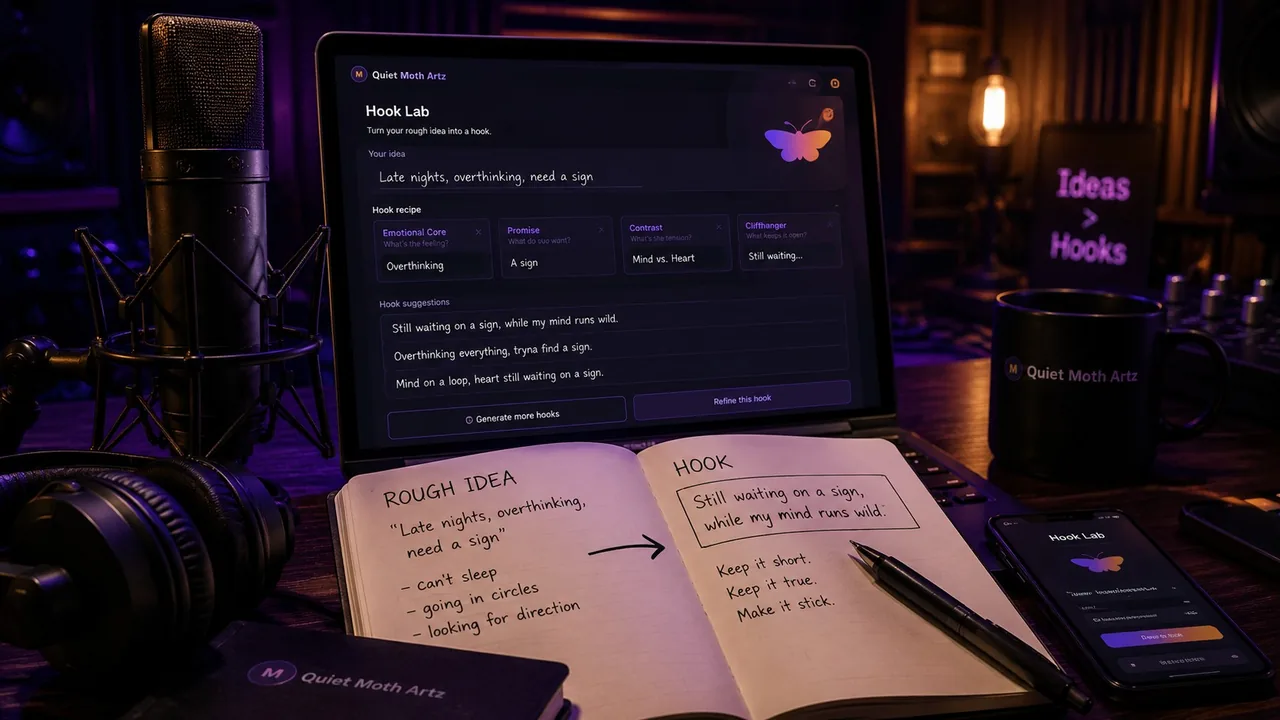
If you need motion, the free Quiet Moth Hook Lab accepts a topic and returns a four-line preview. You can generate another take and copy a result into your notes. Treat it as material to react to: underline one phrase, reject the wrong angle, or use the output to hear what your real song is not. The related Hook Lab build article explains the tool’s deliberately narrow four-line flow.
Custom work is the better path when the hook must fit an exact message, mood, audience, clean or raw direction, or a larger song concept. Quiet Moth Artz’s Songwriting & Hooks service covers hooks, chorus ideas, slogans, chants, verses, and song direction shaped around the project. For music-facing presentation context, see the SquadUp Records case study.
Bring the useful pieces—not a polished brief. In the Request Form, share the plain-language message, the emotion that should lead, any rough phrase or voice note, the intended audience, and references that show the lane. A strong custom hook can start with one sentence that still bothers you.
Free preview or custom writing?
Use the Hook Lab for a free four-line idea preview. For writing shaped around your exact message, mood, and audience, start a custom inquiry.
← Return to Blog